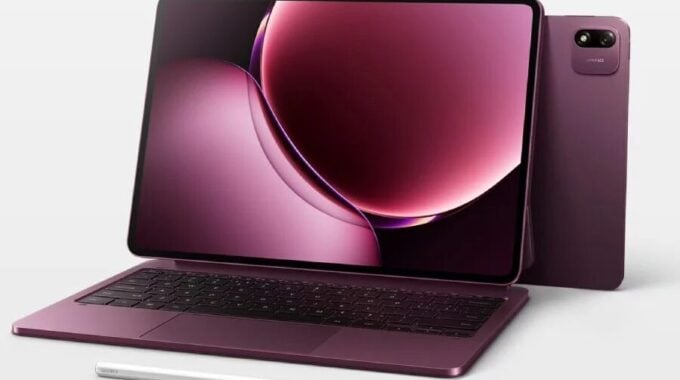
Xiaomi just made a very loud statement. The Pad 9 Pro Max is the company’s biggest, most ambitious tablet yet, and it comes loaded with Xiaomi’s own in-house silicon at a price that makes Apple’s equivalent look eye-watering by comparison. Whether it can actually back up the hype is a different conversation, but on paper, this thing is serious.
As reported by Gizmochina, Xiaomi officially launched the Pad 9 Pro Max at its autumn flagship event. The base model starts at 4,799 yuan, which works out to roughly $715. Go all the way to the top with the 16GB plus 1TB Soft Light Screen version and you’re looking at 7,899 yuan, or around $1,176. That’s still noticeably cheaper than a maxed-out iPad Pro, and that matters.
The display situation
There are two display options here. The standard version gets a glossy 13.3-inch LCD running at 3408 x 2272 resolution with a 3:2 aspect ratio and a 144Hz refresh rate. Peak brightness hits 1,000 nits, and color accuracy sits at a ?E of around 0.47, which is genuinely impressive for a tablet at this price. The Soft Light model swaps the glossy panel for a nano-textured display designed to kill glare. If you’re using this outside or under harsh lighting, that version is worth thinking about. But it does cost significantly more, so choose wisely.
The Xring O3 chip is the real story
This is the first tablet anywhere to run Xiaomi’s Xring O3 chip, and the specs are not messing around. The processor has a 10-core CPU setup with two C1-Ultra cores at 4.35GHz, four C1-Premium cores at 3.68GHz, and four C1-Pro cores at 3.15GHz. Graphics come from a 16-core Mali-G2-Ultra GPU. Early Geekbench multi-core scores are already clearing 14,000 points. Xiaomi is also claiming the combined CPU and GPU performance is close to Apple’s M5. That’s a bold claim, and we’ll need independent testing to verify it. But even if it lands somewhere in the same neighborhood, that’s a huge deal for a non-Apple tablet.
The top-spec model also gets CXMT’s LPDDR6 memory running at up to 10,667Mbps. Fast storage, fast RAM, fast chip. The specs sheet is stacked.
What you can actually do with it
HyperOS 4 brings proper multitasking to the table. You can run up to six apps simultaneously using split-screen layouts, which on a 13.3-inch screen actually makes sense. And here’s the feature that could genuinely change how people use this tablet: the USB-C port supports DisplayPort input, meaning you can plug in a PC or a gaming handheld and use the Pad 9 Pro Max as an external monitor. That’s a real productivity win, not a gimmick.
- 13.3-inch LCD, 3408 x 2272, 144Hz, 1,000 nits peak brightness
- Xring O3 chip with 10-core CPU and 16-core Mali-G2-Ultra GPU
- Up to 16GB LPDDR6 RAM and 1TB storage
- HyperOS 4 with six-app split-screen multitasking
- USB-C with DisplayPort input for use as an external monitor
- Soft Light nano-textured display option to reduce glare
Why this matters beyond the specs
Xiaomi building its own chip is a big deal in the broader context of the Android tablet market. For years, Android tablets have leaned entirely on Qualcomm or MediaTek, while Apple controlled its own silicon destiny and pulled ahead fast. Xiaomi is now following a similar playbook. And launching both the Pad 9 Pro Max and the Xiaomi 18 Fold on the same day, both running the Xring O3, signals that this chip is going to be central to the company’s premium lineup going forward. Pre-orders are open in China now. Global availability hasn’t been confirmed yet, but given how competitive this pricing is, it’s worth keeping a close eye on.