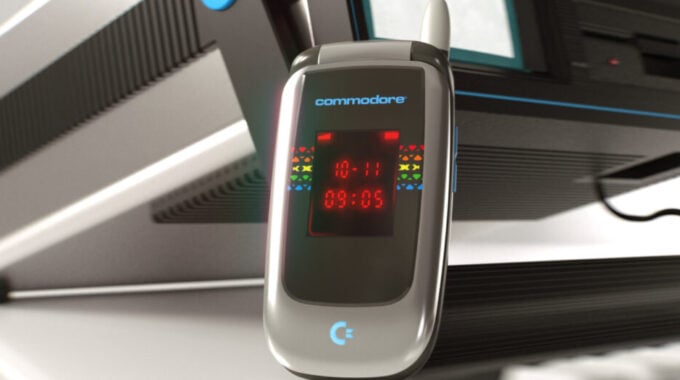
Commodore, the brand best known for the iconic home computers of the 1980s, has been quietly resurrected over the past few years. Its latest move is a flip phone that looks straight out of the ’90s and is built specifically to keep you off social media. As reported by Engadget, the Commodore Callback 8020 is the first phone to carry the Commodore name since the PET in 2015, and it takes a very different approach to what a smartphone should actually do.
The company describes it as a “retreat from Black Mirror technology.” That’s not just marketing copy. The Callback 8020 uses patent-pending technology to enforce a system-level block on social media apps, web browsers, and email clients. If you try to get around it, Commodore has also blocked those services at the DNS level, meaning even a sideloaded app won’t be able to reach its servers.
It’s an interesting bet in a market that’s slowly warming up to the idea of intentional phone use. The “dumbphone” category has been growing steadily, driven by parents, burnout cases, and people who’ve simply had enough of the attention economy. But most minimal phones sacrifice too much to be practical daily drivers. Commodore is trying to occupy the middle ground.
The phone runs Sailfish OS, a Linux-based operating system developed by Jolla, a Finnish company founded by Nokia veterans. Commodore says it offers a “completely de-Googled experience” that’s still compatible with over 99 percent of Android apps through a runtime compatibility layer. That means you can run:
- Signal
- Spotify
- Google Maps
- iMessage (via Mac approval, though this has historically been unreliable on non-Apple devices)
Apps are available through Commodore’s own store, called the Commostore, and the company says it supports sideloading of almost anything that isn’t on its blocked list. That list is fixed. Commodore says it has “drawn a firm line in the sand” around doomscrolling apps and won’t budge.
The privacy angle is also a selling point. Commodore says it won’t collect data without consent, won’t monetize any data you do share, won’t track cookies, and won’t monitor how you use the phone. Despite blocking browsers, the phone keeps an active internet connection for things like QR code scanning and navigation.
On the hardware side, the Callback 8020 is a proper flip phone with some retro character baked in:
- 3.25-inch IPS main display inside
- 1.77-inch VFD-style display on the front cover
- MediaTek Helio G81 processor
- 4GB RAM, 64GB storage
- 32GB microSD card included (expandable to 256GB)
- 48MP rear camera with flash, plus a selfie camera with autofocus
- Wi-Fi, Bluetooth, GPS
- 3.5mm headphone jack with a built-in DAC
- USB-C charging
- FM radio
- 1550 mAh swappable battery
Instead of on-screen notifications piling up, the phone uses a dome LED light to signal new messages. There’s also predictive text built in, which feels like a deliberate throwback to the pre-smartphone era.
The Commodore heritage is front and center throughout the device. It ships with pre-loaded Commodore 64 games plus Snake, a music player that supports the SID chip format (the sound chip from the original C64), licensed classic SID ringtones, and an exterior display design inspired by Commodore’s calculators from the 1970s. The included earphones are HD in-ear monitors, which is a surprisingly premium touch for a phone in this category.
Commodore CEO Peri Fractic says the phone was inspired by his own decision to give up his smartphone after becoming a parent. He found that existing minimal phones were too stripped-down to be useful, so the goal was to build what he calls the “not dumb dumbphone,” something that cuts out the noise without cutting out the tools people actually need.
The Callback 8020 will go on sale later in 2026. Pricing breaks down as follows:
- $500 for Basic Beige, ProtoPET White, or SX Silver
- $550 for the translucent Starlight Edition
- $640 for the PVD gold Founders Edition, which includes a 24k gold-plated “C+” button
Pre-orders open soon, with Commodore targeting a Q4 2026 ship date. At $500 to $640, this sits comfortably in mid-range smartphone territory, which means buyers are making a clear value trade. They’re not saving money by going minimal. They’re paying for the decision to opt out.